Rented farmhouse
American WomanThe Rented farmhouse is a remote refuge whose isolation both shelters Jenny and the fugitives Juan, Yvonne, and Pauline and narrows their world to the house and its tense routines. Set amid forested hills and agricultural valleys, it offers distance from the towns and from the search for the missing fugitives, but not lasting security: the occupants remain hidden, dependent on one another, and alert to an unfamiliar car approaching the house.
Setting and Isolation
Driving west from the farmhouse, Jenny passes through forested hills and broad agricultural valleys where farm buildings and cattle appear only intermittently. Town signs promise settlements without making them visible. Ferndale, which she crosses without stopping, amounts to a post office, an Agway, and a church. The landscape feels unlike Rhinebeck and Rhinecliff, whose farms and river traffic had once seemed to Jenny like the country; those places, she realizes, were outposts connected to New York, while this region feels like a lost land connected to nothing.
After continuing beyond Ferndale, Jenny reaches a junction with a four-lane state highway, buys newspapers, and goes on to Monticello. There she surveys three grocery stores before choosing the one with the oldest, shabbiest-looking parking lot. She shops quickly, filling her cart with canned soup, chili, spaghetti, beans, corn, tuna, and even bread in a can. The trip shows the practical work required to sustain life at the farmhouse: supplies must be brought in from town, and Jenny must do that ordinary errand while keeping a low profile.
The House as a Fugitive Hideout
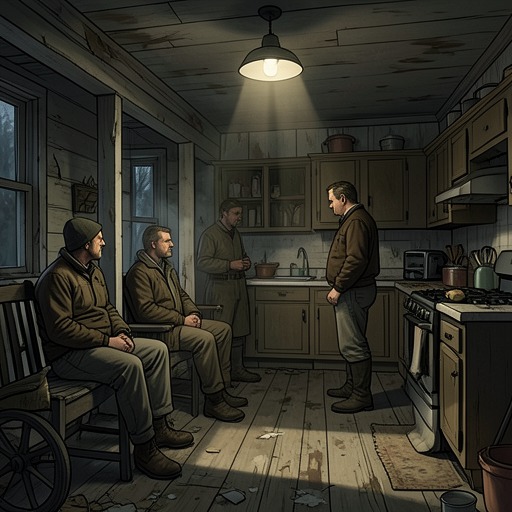
The farmhouse’s front room becomes a sealed, airless communal space. When Jenny returns with groceries, the windows are shut and the drapes drawn; smoke hangs in the room. Pauline lies curled on the couch with a newspaper crossword and a pencil, while Juan and Yvonne are on the floor. A small radio plays through static, its music left unattended. Their unwashed bodies and the smell of wine deepen the sense of confinement. The house protects the fugitives from view, but its closed rooms also make their separation from ordinary life physically palpable.
Jenny brings the newspapers and news magazines as evidence of how the manhunt is developing. The previous week’s covers had shown black smoke, orange flame, and the headline Surrounded!; reports had confirmed nine dead by identification through their teeth and listed Juan, Yvonne, and Pauline as missing. The newer headlines have moved on to other stories. Jenny tells them that the fugitives have disappeared without a trace and that the FBI is searching in Los Angeles and points south, even as sightings are reported across the West Coast. The reports offer a brief measure of relief, but the house remains a place where safety depends on staying unnoticed.
Uneasy Domestic Routine
Life at the farmhouse is not simply concealment; it requires the occupants to share work and space despite their internal divisions. The day after a rift, Jenny and Frazer dig a fire pit behind the house, lining it with flat stones gathered from the hillside. Juan hauls dead branches from the woods, while Pauline and Yvonne prepare salad inside. Music plays from a radio set in the window, carrying out on the breeze, but the gathering does not restore ease. At the late-afternoon meal the three fugitives barely touch their food and do not speak, leaving Jenny and Frazer to sustain conversation like nervous hosts. Their sullen silence turns a shared meal into a sign of the distance between the fugitives and Frazer.
The meal also becomes a setting for the group’s writing: Frazer asks the others to bring out the pages they have prepared, and Juan tells him to go first. Elsewhere in the farmhouse, their political discussion spirals backward from the war in Vietnam through French colonialism, American foreign policy, and the history of the nation-state. The more they excavate the past, the less attention they give to the present. The farmhouse thus holds both their attempt to make a political account of events and the everyday pressures—food, silence, work, and proximity—that complicate that effort.
Exposure and Suspense
The refuge’s apparent remoteness does not keep the outside world away. While the three occupants are working inside, Jenny hears a car laboring up the hill. Juan assumes Frazer has returned earlier than promised, but the vehicle is not Frazer’s battered brown coupe: a blue four-door sedan comes around the last turn of the drive. Jenny recognizes that the person inside is unknown, though she can see little more than a hint of the occupant. Juan orders Pauline upstairs. The scene ends with the farmhouse changing in an instant from secluded shelter to a point of possible exposure, its isolation offering no answer to who has found the road to it.